
Albertsons Companies
Merch Command Center
Connecting item, pricing, promotion, supplier and cost decisions through one merchandising workspace.
- My role
- Director, UX Product Design & Innovation
- Period
- Feb 2022 – Present
- Designed for
- Merchants & suppliers
AI leadership noteTrace a recommendation back to the item
Original approach
Connected enterprise design-system direction with application delivery in Merchandising, bringing shared navigation, tokens and interaction patterns into product workflows.
What could change today
Start with a merchant asking why two item records disagree. Retrieve the supplier submission, price history and effective dates, then draft a comparison with links to the records. Give the merchant control of the correction.
Workflow excerpt. The numbered steps show the same part of the journey in each version. The full project includes work beyond this comparison.
Original workflow
- Orient in the dashboard
- Choose a business domain
- Inspect the task context
- Take the next action
Proposed workflow with AI
- Surface exceptions on the merchant’s dashboard.
- Select the domain and narrow the affected items.
- Compare conflicting supplier records with linked evidence.
- Let the merchant approve the correction and see its status.
How to test the change
Test stale prices, missing supplier data and conflicting effective dates. Record whether the merchant can find and correct the source.
01 / Customer & problem
The need behind the work.
Who needed this.
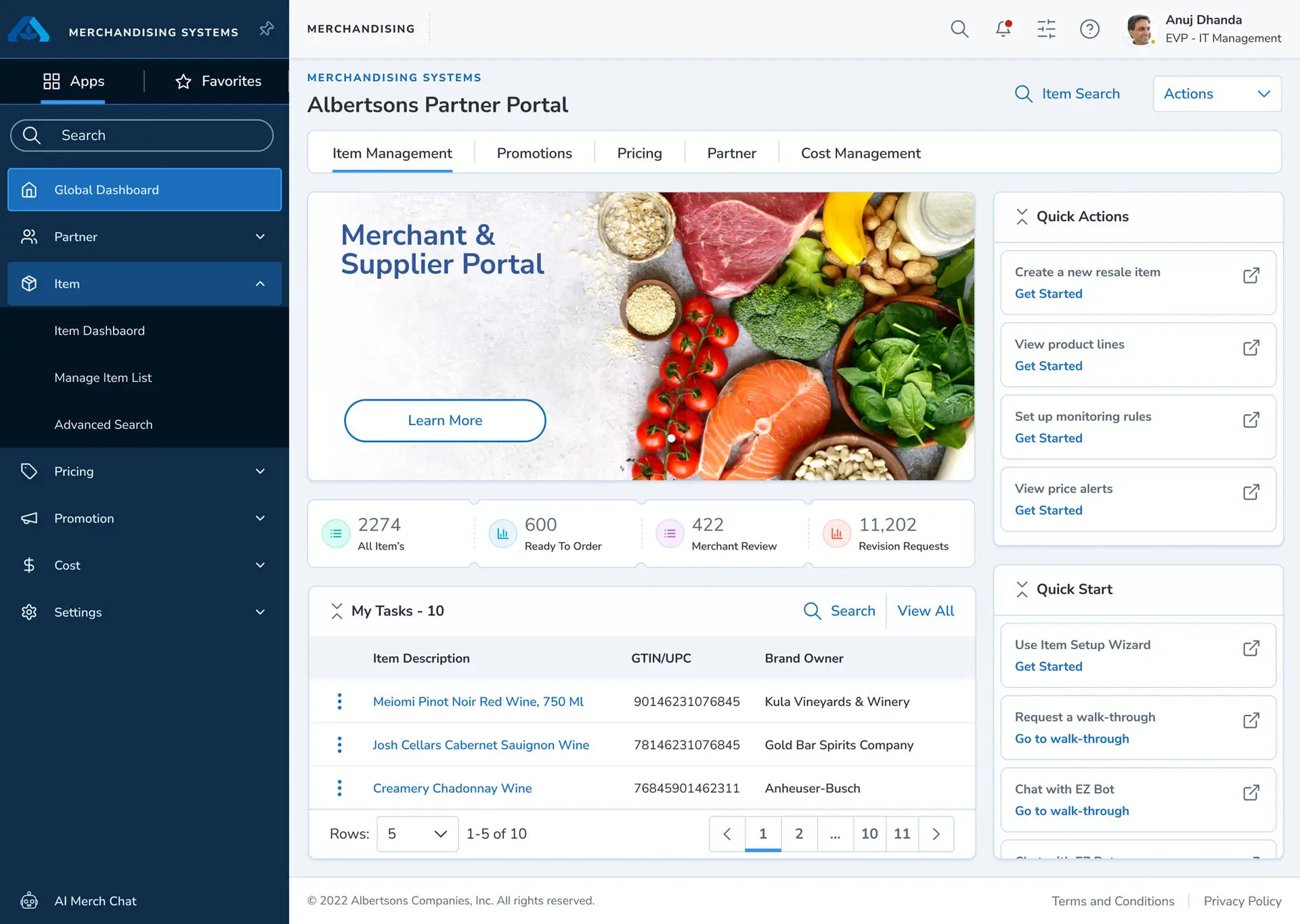
Merchants and suppliers need a coherent route into item, promotion, pricing, partner and cost-management work.
The problem to solve.
Merchandising work crosses multiple domains, tools and teams. Fragmented navigation and inconsistent patterns make it harder to move from an overview to the next operational action.
Give merchants and suppliers a coherent entry point, shared navigation and a clear path into the work.
02 / My ownership
Responsibilities.
Led UX direction and design-system ownership within a multidisciplinary delivery organization. Merchandising, engineering and product partners contributed to the application work.
The constraint to work through.
A common entry point must serve multiple business domains while keeping task-specific actions close to the relevant information.
- Orient in the dashboard
- Choose a business domain
- Inspect the task context
- Take the next action
03 / Actions & delivery
How the work came together.
Connected enterprise design-system direction with application delivery in Merchandising, bringing shared navigation, tokens and interaction patterns into product workflows.
The dashboard organizes item management, promotions, pricing, partners and cost management, with quick actions close to the task context.
04 / Decisions & judgment
What carries through the design.
Connect overview and action.
A dashboard should help someone decide where to go and what to do next. Shared navigation and contextual actions connect the summary to working tasks.
Use the platform as a foundation.
A common product language gives different merchandising domains a consistent starting point while preserving their task-specific needs.
05 / Results & business value
What changed through the work.
A connected merchandising dashboard and shared navigation approach, supported by UDS foundations and the broader platform operating model.
Why it matters.
Shared navigation connects merchants and suppliers to related business domains without requiring each domain to establish a separate starting point. UDS patterns make the dashboard part of a wider implementation foundation.
06 / Reflection
Lessons for future projects.
Use the dashboard as a route into work rather than a destination for disconnected metrics. Overview and action need a continuous relationship.
Let’s talk about your next chapter.
Exploring Senior Director, Head of Design and VP opportunities.