
Walmart · Data Science
Libra: planning the shortest path to a complete order.
An internal Walmart picking application that turns a customer order and store floor map into an efficient route through the aisles.
- My role
- Lead UX Technologist · Data Science Platforms
- Period
- Oct 2019 – Feb 2022
- Designed for
- Online-order pickers
AI leadership noteExplain a route and recover from a blocked aisle
Original approach
The workflow connects a customer’s ordered items to their locations on the store floor map. The entry point matters because the best picking sequence depends on where the picker starts.
What could change today
Keep store maps and route optimization responsible for pick order. Use a language interface for exceptions such as a blocked aisle, then ask the route solver for a revised path from the picker’s current position.
Workflow excerpt. The numbered steps show the same part of the journey in each version. The full project includes work beyond this comparison.
Original workflow
- Choose the entrance
- Map the ordered items
- Follow the picking route
- Checkout & delivery
Proposed workflow with AI
- Set the picker’s actual entrance and order.
- Locate ordered items on the store’s current floor map.
- Follow the proposed route and recalculate for a blocked aisle.
- Check the picked order and hand it off for delivery.
How to test the change
Walk the revised route from different entrances. Compare distance, missed items and whether the picker can override a bad suggestion.
01 / Customer & problem
The need behind the work.
Who needed this.
Walmart order pickers need to collect every ordered item efficiently from whichever store entrance they use.
The problem to solve.
Picking an online order means finding products across a large store. An unordered shopping list can send a picker back through aisles they have already visited, with different entrances and store layouts adding complexity.
Use the floor map of each Walmart to sequence the items on a customer’s order from the picker’s chosen entrance, through the store and on to checkout and delivery.
02 / My ownership
Responsibilities.
My UX work on Libra sat within Walmart’s Data Science Platforms organization. The application was a collaborative hackathon effort that became an internal project; store mapping and route planning were part of the wider team’s work.
The constraint to work through.
The route depends on a specific floor map, starting entrance and item locations. A generic product list cannot establish an efficient physical sequence.
- Choose the entrance
- Map the ordered items
- Follow the picking route
- Checkout & delivery
03 / Actions & delivery
How the work came together.
The workflow connects a customer’s ordered items to their locations on the store floor map. The entry point matters because the best picking sequence depends on where the picker starts.
Libra organizes the shopping list around the route, helping the picker collect items in order rather than navigate the store through repeated detours. The project began in a Walmart hackathon and became an actual internal project.
04 / Decisions & judgment
What carries through the design.
Start with the physical store.
A route needs to reflect the specific floor map and the entrance being used. The same item list can require a different sequence in a different location.
Sequence the work around the route.
The interface connects the order to an ordered picking task, supporting a continuous path from entry to item collection and checkout.
The experience in detail
From an online order to an in-store picking route.
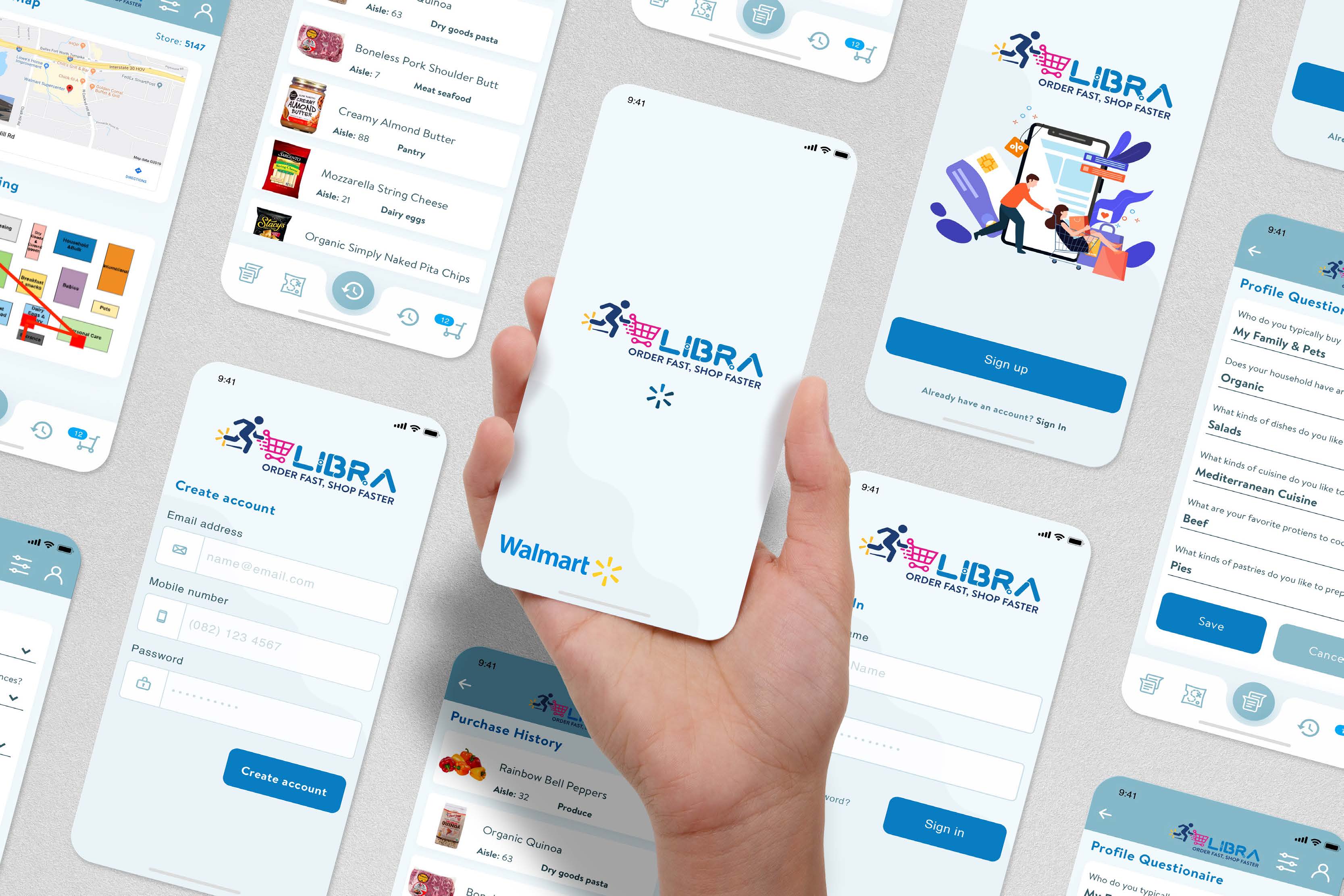
Libra connects the ordered items to a store floor map, then sequences collection from the picker’s entrance through the aisles to checkout.
Store context → ordered items → picking route
The mobile design brings the shopping list and store map into the same experience. The operational task is internal order fulfillment, with the item sequence shaped by the starting entrance.
05 / Results & business value
What changed through the work.
A Walmart hackathon concept developed into an internal project for map-based order picking. Libra connected store layouts and customer shopping lists to route planning for online-order fulfillment.
Why it matters.
Sequencing the list around a store map targets avoidable aisle travel in online-order fulfillment. The route connects a customer’s order to the physical work required to complete it.
06 / Reflection
Lessons for future projects.
Keep the starting point and physical layout in the core workflow. Location-aware work needs a route shaped around the environment, not only a reordered list.
Let’s talk about your next chapter.
Exploring Senior Director, Head of Design and VP opportunities.